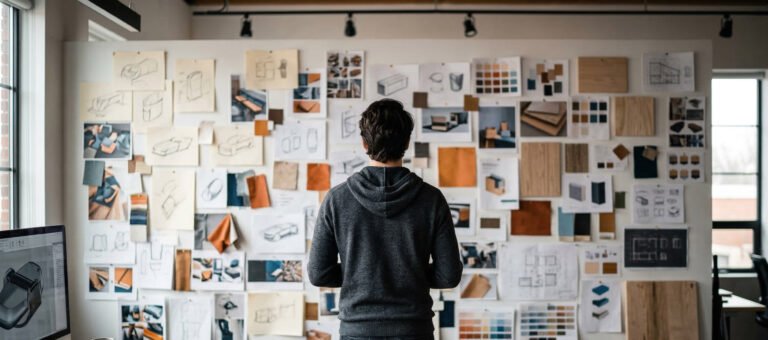
Last Tuesday I was covered in MDF dust, working on a prototype in my workshop. My phone buzzed across the room with a notification, but I ignored it. I didn’t want to look at a glowing rectangle. I just wanted to feel the satisfying, heavy click of that analog knob.
That late-night craving for tactile feedback wasn’t just a personal quirk. It’s a microcosm of a massive societal shift happening right now.
As industrial designers, we don’t create in a vacuum. The products we build are direct physical manifestations of our cultural anxieties, geopolitical pressures, and collective desires. Right now, society is exhausted. We are over-stimulated, hyper-connected, and drowning in a sea of cheap, disposable goods.
The physical product design trends we are seeing emerge for 2026 aren’t just about new aesthetics or Pantone colors. They are survival mechanisms. They are our attempt to design the antidote to modern life.
The Screen-Free Rebellion: Craving the Tangible
For the last fifteen years, the tech industry’s answer to every problem was to slap a touchscreen on it. Refrigerators, cars, coffee makers, everything became a glowing, homogenous glass slab. But society is hitting a breaking point.
Digital fatigue is no longer just a buzzword; it’s a public health crisis. We are biologically tired of swiping.
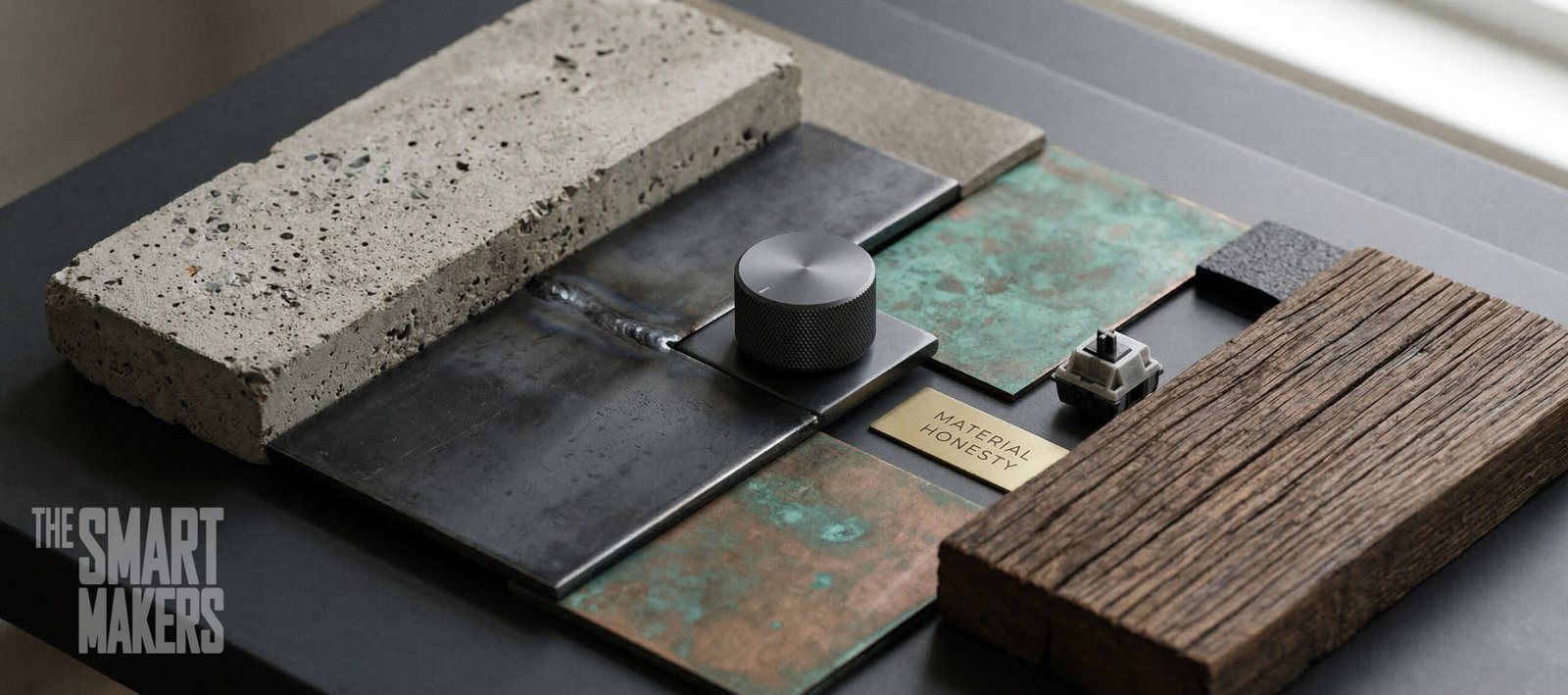
This societal burnout is driving a massive trend in industrial design: The return of material honesty and tactile interfaces. People are actively seeking products that pull their eyes away from screens. We are seeing a surge in «dumb» devices, single-purpose hardware that does one thing exceptionally well, without an app, without a subscription, and without Wi-Fi.
- The Societal Driver: A desperate need for digital boundaries and mental presence.
- The Design Response: Heavy, knurled knobs. E-ink displays that don’t emit blue light. Devices wrapped in warm, acoustic fabrics or raw metals that age and patinate over time.
«We aren’t designing products just to perform functions anymore; we are designing products to protect our attention.»
When designing to block out concepts now, my team and I actively ask: Can we remove the screen entirely? Can this be communicated through a haptic pulse or a mechanical switch? We are trying to cure the very digital hangover our industry helped create.
The Simplification Movement: A Detox from Disinformation
Take a look at the geopolitical landscape and the 24/7 news cycle. It is a relentless firehose of information, disinformation, targeted ads, and algorithmic outrage. Our environments feel chaotic and entirely out of our control.
How does this shape industrial design? It creates a profound yearning for visual and cognitive silence.
Consumers are rejecting the «feature bloat» of the early 2020s. We don’t want a microwave that tweets. We want objects that are quiet, intuitive, and demand absolutely nothing from us. This goes beyond traditional minimalism. It’s about cognitive ergonomics.
- The Societal Driver: Information overload, algorithmic anxiety, and a loss of personal autonomy.
- The Design Response: Stripped-back interfaces, opaque and solid forms, and localized processing.
People want products that feel like safe havens. They want local storage instead of cloud dependency (a direct reaction to data privacy fears). They want clean, uninterrupted surfaces that don’t blink with status LEDs. By designing simpler, quieter products, we are literally trying to lower the resting heart rate of the user.
The Anti-Consumerism Shift: From Disposable to Generational
Early in my career, I tried to launch a fully biodegradable consumer electronics casing for my independent Shopify brand. I was determined to save the world. It was a logistical and financial disaster. The bio-resin crumbled under basic UV exposure, the supply chain was unstable, and the failure rate was abysmal.
That failure taught me a hard lesson about sustainability: True anti-consumerism isn’t just about using compostable plastics. It’s about building things that people refuse to throw away.
Society is waking up to the environmental devastation of fast-tech and disposable culture. Furthermore, geopolitical volatility and the looming «tariff storms» are making global supply chains fragile. It is becoming harder and more expensive to ship cheap plastic junk across the globe.
This is fundamentally altering product architecture.
- The Societal Driver: Climate anxiety, inflation, and a revolt against planned obsolescence.
- The Design Response: The «Right to Repair» movement built directly into the CAD files.
We are seeing a trend toward exposed fasteners, modular components, and standard screw heads. We are designing products that look robust, utilitarian, and repairable. We are celebrating the grit, texture, and unpredictability of recycled materials instead of hiding them under a layer of glossy paint.
If you want to survive as a hardware entrepreneur today, you need to use tools that help you optimize for longevity. I rely heavily on AI-driven generative design to calculate stress points and optimize part geometry so we can use less material while making the product twice as strong. [Affiliate Link: Check out my recommended 3D printing filaments for high-durability prototyping here].
The Impact: Designing for Human Flourishing
So, what is the ultimate impact of these trends?
When we design a tactile alarm clock that allows someone to leave their smartphone in the kitchen overnight, we are improving their sleep. When we design a repairable appliance, we are giving the user a sense of ownership and reducing landfill mass. When we design a quiet, single-purpose tool, we are giving someone their focus back.
Industrial design is a mirror reflecting society’s deepest needs. Right now, society needs healing. We need grounding. We need the physical world to feel solid, reliable, and respectful of our humanity.
As designers, we are the guardians of good taste, but more importantly, we are the guardians of the user experience. AI can help us calculate the optimal wall thickness of a part, or render a concept in three seconds flat. But it takes a human designer to look at society, recognize its exhaustion, and decide to build something that offers peace.
The future of physical products isn’t about doing more. It’s about doing exactly enough, and nothing more.
What’s your take? Are you seeing this shift away from screens in your own product development cycles? Let me know in the comments below.
For more on the latest Design Trends check my post about them, 2026 Design Trends and if you like what you see, download the full document for free.
Until next time, keep making it real.
About the Author: I am a professional Industrial Designer, e-commerce entrepreneur, and design team manager. With over 20 years of experience bridging the gap between sketching, CAD, and manufacturing, I now explore how Artificial Intelligence is reshaping the way we build physical and digital products.