If you had told me two years ago that my most valuable design companion wouldn’t be a fresh marker, a Wacom tablet, or a CAD program, but a chat window, I would have laughed.
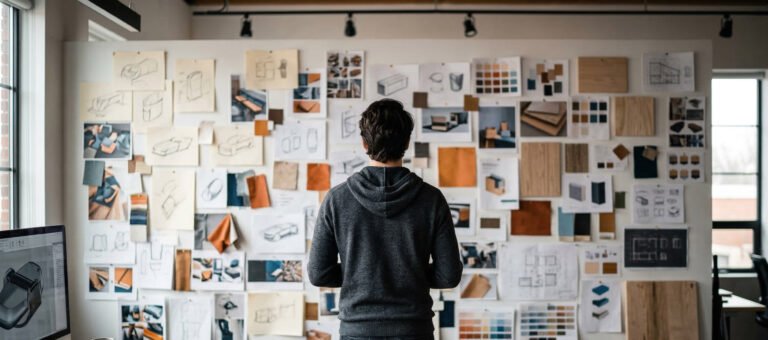
I have been designing physical products since I was 10. Like many industrial designers, my journey started with an obsession for cars—sketching complex curves, studying aerodynamics, and trying to make objects look as fast as they felt. Today, in my full-time job, I manage a team of talented designers at a large corporation. My day-to-day involves turning abstract ideas into tangible, manufacturable reality.
For a long time, I was a massive skeptic of Artificial Intelligence. Up until 2024, I viewed AI as a fun toy for creating trippy digital art, but certainly not a «real» tool for the rigorous, dimensionally-accurate world of industrial design.
I was wrong. AI hasn’t just become a tool in my workflow; it has fundamentally re-engineered the design process itself.
Here is exactly how my workflow has changed, why I can’t go back, and why I decided to build The Smart Makers.
Just a couple years ago I could not imagine where we are today, what will the next couple years bring to us?
From Hours of Rendering to Seconds of Ideation
In the traditional industrial design workflow, rendering is a bottleneck. You sketch an idea, build a rough 3D model, set up lighting, apply materials, and wait. If the client or design director doesn’t like it, you start over.
Now, using AI rendering tools (like Vizcom and Midjourney, Gemini), I can feed a rough napkin sketch into the system and get a photorealistic render in seconds. We are no longer limited by the time it takes to execute an idea; we are only limited by the speed at which we can imagine them. This shift means my team and I spend less time on tedious, repetitive tasks, and drastically more time on actual creation.
Eliminating the «Boring» Management Work
As a design manager, a lot of my time used to be eaten up by administrative tasks: writing design briefs, summarizing meeting notes, and structuring project timelines.
Now, I use AI as an active work companion. I can bounce raw, unstructured thoughts off my AI assistant, brainstorm project directions, and have it instantly format those thoughts into a cohesive strategy for my team. It feels less like using software and more like having a tireless co-designer sitting next to me.

«Vibe Coding» and Bridging the Digital Gap
My background is in physical products, but as an entrepreneur with my own e-commerce store (selling my own custom-designed merch and prints), I’ve always wanted to build better digital experiences.
Historically, I didn’t have the time to learn complex web development. Enter «vibe coding»—the 2026 movement of building apps and websites simply by chatting with an AI. Using AI code-generation tools, I am now able to build custom web tools, interactive storefronts, and apps just by describing what I want in plain English. AI writes the code, and I act as the creative director. The barrier between physical and digital design has completely collapsed for me.
Why I Built The Smart Makers
I’ve always been curious, and I believe that the moment a designer stops learning is the moment their work becomes obsolete.
I built The Smart Makers because I saw a massive gap in the industry. There are a million blogs talking about generic AI tools, but very few showing how to actually apply them to physical product design, e-commerce, and real-world manufacturing. On this blog, I am going to share my first-hand experience. No fluff, no theory—just the exact workflows, prompts, and tools I am actively testing in my corporate job and my personal e-commerce business.
Here is what you can expect from me:
- Honest Tool Reviews: I’ll show you exactly how AI rendering, CAD assistants, and vibe-coding tools perform in real-world scenarios.
- Trend Breakdowns: Where industrial design is heading in 2026 and beyond.
- E-commerce Case Studies: How I use design and AI to create, market, and sell physical merchandise.
AI is not here to replace us; it is here to augment us. It is taking the heavy lifting out of the process so we can get back to doing what we love: making smart, beautiful things.
Welcome to the future of the design process. Welcome to The Smart Makers.
About the Author: I am a professional Industrial Designer, e-commerce entrepreneur, and design team manager. With over 20 years of experience bridging the gap between sketching, CAD, and manufacturing, I now explore how Artificial Intelligence is reshaping the way we build physical and digital products.
- Designing the Antidote: How Societal Exhaustion is Shaping the Next Era of Industrial Design
- 6 Jaw-Dropping Hardware Drops from MWC 2026
- The «China Speed» Wake-Up Call: Why We Need to Stop Having Meetings and Start Building
- XPPen Artist Pro 16 (Gen 2) Review: The Ultimate 2.5K Pen Display for Illustrators and Designers?
- 4 Industrial Design Trends Dominating 2026