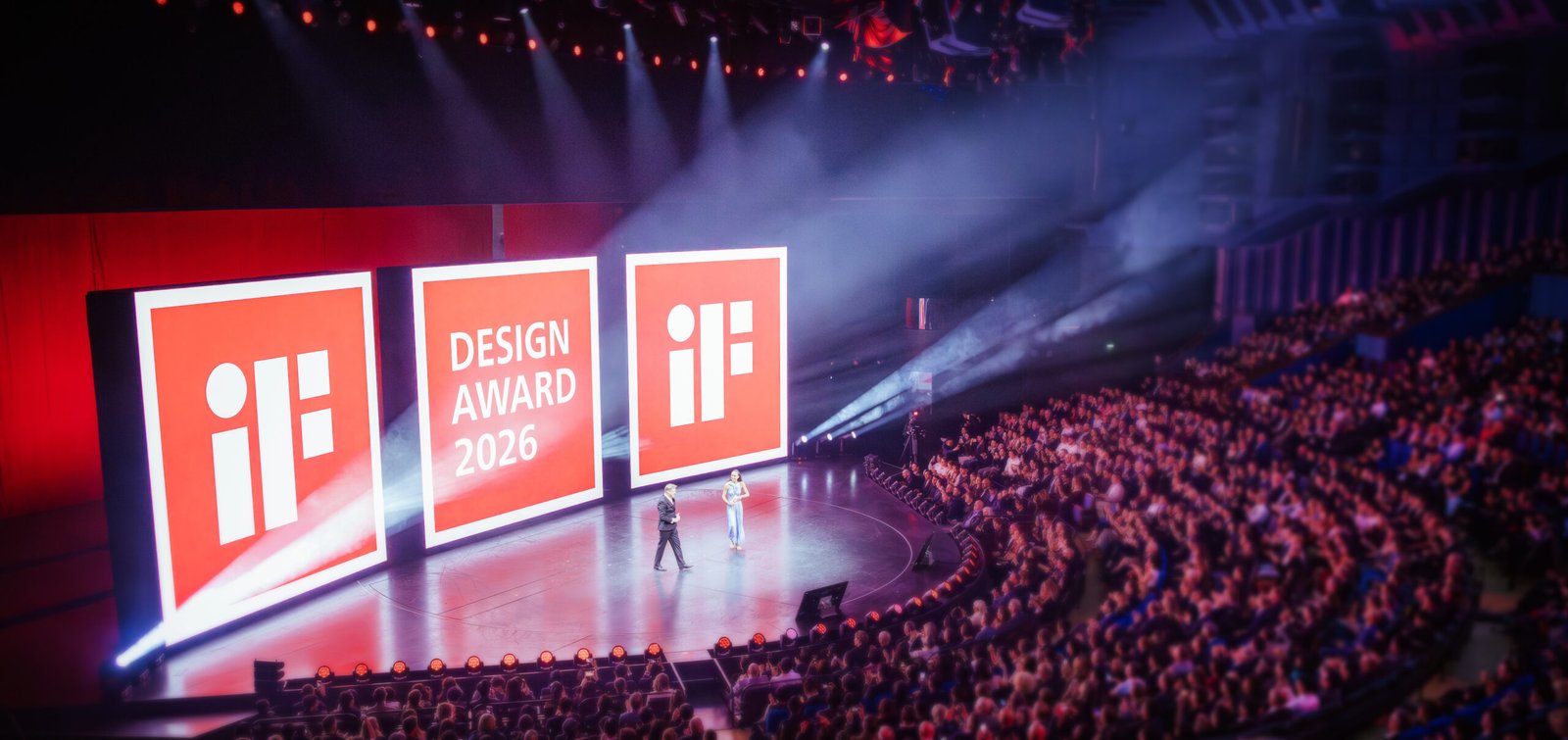
This past Monday, April 27th, over 2,000 designers packed into Berlin’s Friedrichstadt-Palast for the 2026 iF Design Awards. Out of the 10,000+ entries, the prevailing narrative wasn’t just about sleek chamfers or sustainable packaging. The conversation fundamentally shifted.
I am currently putting together a massive deep-dive post analyzing the specific winners and manufacturing techniques, but after the awards and the trend conferences that followed, I couldn’t wait to share a few immediate thoughts.
The reality is stark: the global design hierarchy has flipped, and technology is forcing us into an identity crisis.
Here is what you need to know about where physical product design is heading.
1. The AI Divide: Integration vs. Rebellion
If you walked through the crowds or sat in on the trend conferences the next day, artificial intelligence was the unavoidable elephant in the room. It was in the informal chats by the bar, and it was deeply embedded in the award-winning products themselves.
I get the anxiety. I was highly skeptical of AI until early 2024. But after experiencing a “lightbulb moment” where integrating AI to my designs, my process changed forever. AI isn’t just a gimmick anymore; it’s a structural component of how we ideate.
But what fascinated me at the awards was the reaction to AI. We are seeing two massive extremes:
- The Seamless Integrators: Products where AI isn’t just a software layer, but dictates the physical geometry, generatively designed housings optimized for minimal material usage, or adaptive interfaces.
- The “Anti-AI” Analog Backlash: A noticeable surge in hyper-tactile, heavy, analog products. We are seeing designs leaning hard into visible hardware, raw materials, and mechanical switches just to prove human hands made them.
Designers are actively using physical products as a cultural rebellion against purely digital, automated generation.
2. The Great Geographic Shift
For decades, European and American design studios walked into these awards with an unspoken assumption: We are the benchmark. That era is officially over.
I’ve spent a lot of time on factory floors overseas, negotiating with suppliers and turning CAD files into physical realities. I watched the capability of Asian manufacturers evolve in real-time. But what we saw on Monday proved that the old narrative, “The West designs, the East manufactures”, is completely dead.
Asian studios, independent designers, and massive regional brands are winning awards for absolutely spectacular, emotionally resonant, and culturally nuanced designs. Their integration of smart technology with traditional craftsmanship is outpacing legacy Western brands.
This is not a threat; it is a massive opportunity.
If European and American designers drop the ego, we can learn an incredible amount from how these studios approach form, user experience, and rapid hardware iteration. The moment you think you are the permanent benchmark is the moment your portfolio becomes obsolete.
“The global standard for good taste has decentralized. To be a great designer today means looking outside your own cultural bubble for inspiration.”
3. Design is Not Dead. It is Reacting.
With the flood of AI-generated concepts on social media and the shifting global dynamics, it is easy for junior designers to feel like the industry is shrinking or dying.
Monday night proved the exact opposite. Design is not dead.
Design is actively reacting. It is shaping our environments, capturing our collective cultural anxieties, and dictating how we interact with new, intimidating technologies. The human designer’s role, what I call being the “guardian of good taste”, has never been more critical. AI can give you a thousand variations of a chair in seconds, but only a human designer knows how that chair feels in a specific room, in a specific culture, on a specific day.
I’ll be breaking down my favorite products, the CAD workflows behind them, and the materials they used in next week’s deep dive.
Until then, keep building.
About the Author: I am a professional Industrial Designer, e-commerce entrepreneur, and design team manager. With over 20 years of experience bridging the gap between sketching, CAD, and manufacturing, I now explore how Artificial Intelligence is reshaping the way we build physical and digital products.